-
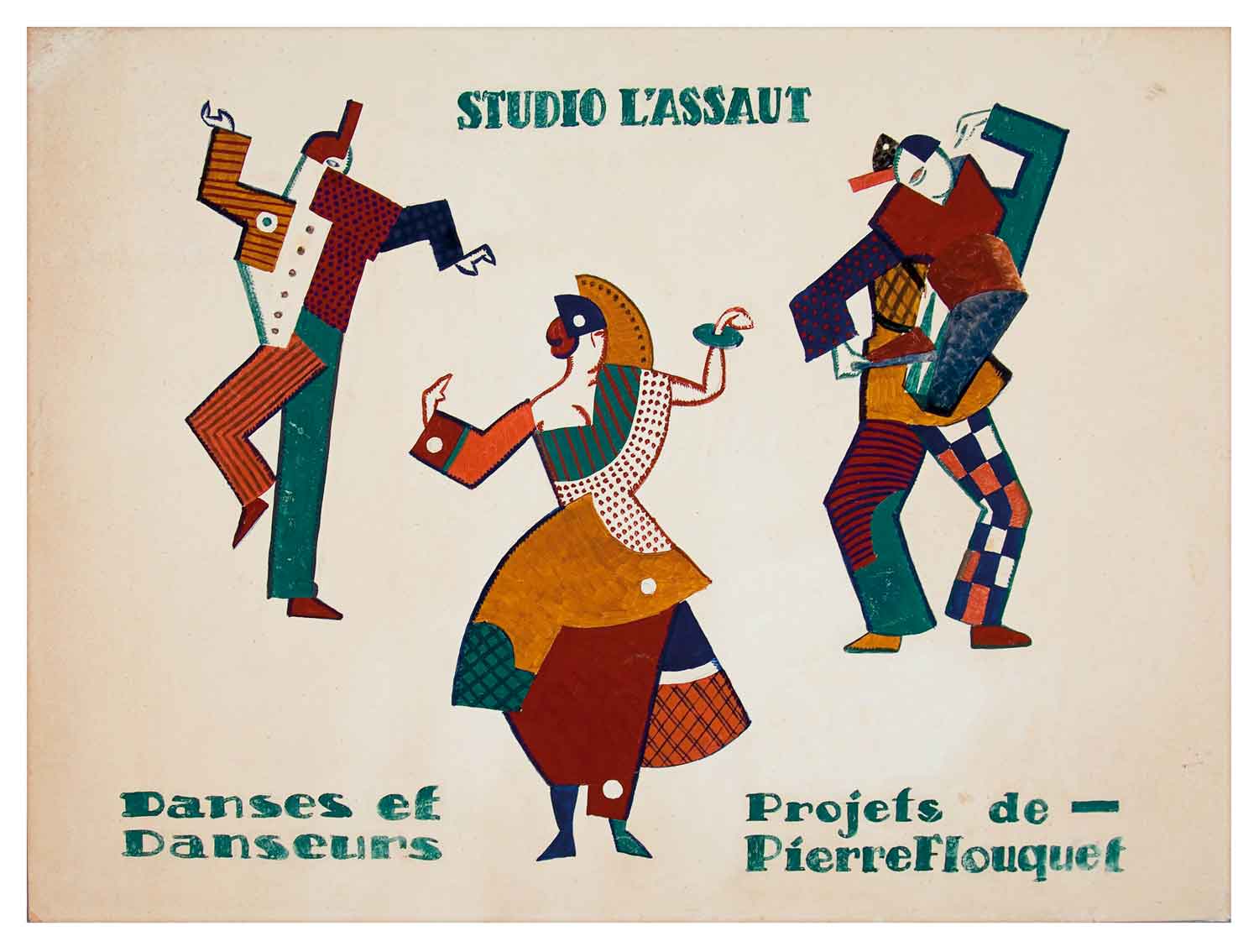
PIERRE- LOUIS FLOUQUET (French, 1900- 1967)Studio l’assaut – Danses et Danseurs, 1925, gouache on paperCRP116
Born in Paris. In 1910 his family moved to Brussels, where he studied with Constant Montald and Gisbert Combaz at the Academy of Fine Arts. Flouquet connected with the avant-garde of Antwerp, Berlin, Brussels, Lausanne, and Paris, sharing a studio with Magritte in Brussels. In modernist circles, he was known for his abstractions and biomorphic and geometric works. In 1921 the artist took part in the International Exhibition of Modern Art (Geneva) and, with René Magritte, in the Centre d’Art (Brussels). Flouquet was co-founder of the avant-garde group 7 Arts; he was responsible for the painting section of its magazine and its illustrator. Alongside Serguei Eisenstein, Max Ernst, Walter Gropius, Oskar Schlemmer, Victor Servranckx and others, he was a regular guest at Baroness Hélène de Mandrot’s Maison des Artistes, at her Château de La Sarraz, near Lausanne, where the First International Congress of Modern Architecture, the First Congress of Independent Cinema in 1929 and many other early 20th century revolutionary artistic manifestations were held. Hélène de Mandrot, like Katherine Dreier and Gertrude Stein, is one of the mainstays of modern art. In 1925, Flouquet founded the L’Assaut group with Jean-Jacques Gailliard and organised exhibitions under his aegis. As a leader of La Plastique Pure, he regularly exhibited abroad: Buenos Aires, Chicago, Leipzig, Madrid, Monza, New York, Paris, Philadelphia and Zurich; on his own at the Der Sturm gallery in 1925 andat the Deutsche Werkbund (Stuttgart) in 1927, founded by Henry van de Velde, who invited him. He designed many covers for the revolutionary art magazine Der Sturm. His work can be found in museums such as the Musées Royaux des Beaux-Arts de Belgique (Brussels and Antwerp), the Museum voor Schone Kunsten (Ghent) and the Musée de Grenoble; it has been exhibited at the Stedelijk Museum Lakenhal (Leiden), the Museum voor Schone Kunsten (Ghent), and Tate Modern (London), among others.
-
THEO VAN DOESBURG (Dutch, 1883-1931)Bird cage, 1917, mixed media, 177,5 x 96 x 40CRP141
A painter, decorator, poet, and art theorist born in Utrecht, and one of the creators of the De Stijl movement. From 1914 to 1916, Doesburg served in the Dutch army. The artist started off painting in a naturalist style; in 1916 he began creating geometric abstractions of natural subjects. In 1917 Doesburg founded De Stijl and its avant-garde art magazine together with Piet Mondrian, Georges Vantongerloo and others. From 1921 to 1923, he taught at the Bauhaus Weimar, with Le Corbusier and Mies van der Rohe; this period reveals the strong influence of Mondrian and Neoplasticism. The artist was also interested in Dada and worked with Kurt Schwitters, Jean Arp and Tristan Tzara on the magazine Mécano. He exhibited his architectural designs in Paris in 1923 and 1924, and he announced a new phase for De Stijl in a manifesto explaining his concept of “Elementarism” (1926). Doesburg returned to Paris in 1929 and published the first issue of Art Concret, the organ of the group bearing the same name, and was the driving force behind the formation of the group Abstraction-Création (Paris).
-
Monograma «PL», 1911, gouache and collage on paper mounted on cardboard.CRP101